What your ETF expense ratio is really costing you



Let’s say you’re a business owner reviewing vendor contracts. You’d probably pay close attention to what you’re spending and why. Many people apply that same logic to obvious line items — but are you applying that to your investment portfolio? Expense ratios are one of those costs that are easy to overlook. They’re small percentages, automatically deducted, never invoiced. But over a long time horizon, they can have a meaningful impact on how much of your money actually stays invested and working for you.
What is an expense ratio?
An expense ratio is the annual fee a fund charges to cover its operating costs — things like portfolio management, administration, and marketing. It’s expressed as a percentage of your investment and deducted automatically from the fund’s returns, so you never write a check. But you pay it every year you hold the fund.
Here’s how that plays out in practice:
A fund with a 0.10% expense ratio on a $100,000 investment costs $100 per year. A fund with a 1.00% expense ratio on the same investment costs $1,000 per year.
That $900 annual difference may not feel significant on its own. Compound it over decades, and it adds up.
So what does this look like in the real world? It helps to understand the types of funds you might encounter — and how their costs compare.
How ETFs compare to mutual funds on cost
ETFs (exchange-traded funds) and mutual funds both give investors access to a diversified basket of securities — but they tend to differ significantly in cost structure.
Mutual funds — particularly actively managed ones — often carry higher expense ratios because they require ongoing research, portfolio management, and trading activity. According to the Investment Company Institute, the average expense ratio for actively managed equity mutual funds was around 0.66% in recent years. For some investors, especially those seeking professional portfolio management or more complex strategies, that active management may provide value worth the cost.
ETFs, by contrast, are often structured as passive index funds that track a benchmark rather than trying to beat it. That passive approach typically requires less active management, which translates to lower operating costs. Many broad market ETFs charge between 0.03% and 0.20%.
That difference in cost structure is one reason ETFs have become a popular choice for cost-conscious, long-term investors. That said, ETFs aren’t perfect for every situation. Some ETFs can be thinly traded, making them harder to buy or sell without paying wider spreads. And if you’re looking for active portfolio management or personalized guidance — something mutual fund managers often provide — an ETF-focused approach may require you to make more decisions on your own.
Now, you might be wondering: how much does this difference actually matter over time? Let’s put some numbers to it.
Understanding the long-term impact of fees
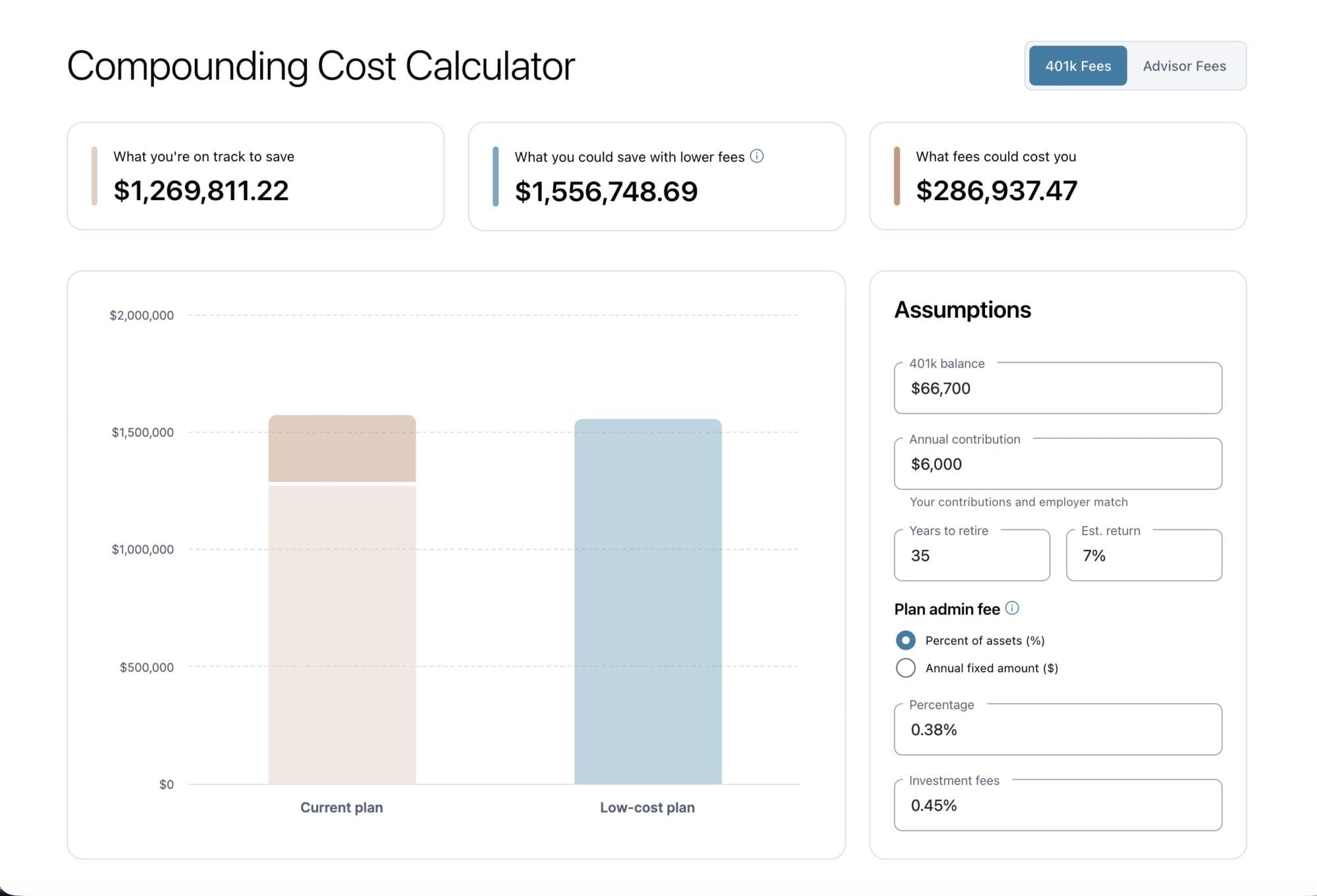
When you’re investing for decades, small percentage differences can turn into significant dollar differences. Here’s how:
Hypothetical scenario: You invest $100,000 and add $10,000 annually for 30 years, earning 7% average annual returns before fees.
With a 0.10% expense ratio: Ending balance: ~$1,132,000 Total fees paid: ~$22,000
With a 1.00% expense ratio: Ending balance: ~$985,000 Total fees paid: ~$169,000
The difference: Approximately $147,000 over 30 years in this example.
Important disclosures:
- These figures are hypothetical and for illustrative purposes only
- They assume consistent 7% annual returns
- Actual investment returns vary
- Market volatility, changing economic conditions, and other factors will affect actual results
- This is not a prediction or guarantee of future performance
- All investing involves risk, including the potential loss of principal
While you can’t control market returns, understanding fee structures can help you make informed decisions about investment costs that are within your control.
Of course, not all expense ratios are the same. The right benchmark depends on the type of fund you’re looking at.
What‘s a competitive expense ratio?
Context matters. Different fund types have different cost structures.
| Type | Exposure | Typical range |
| Broad market index ETFs | S&P 500, total stock market | 0.03%–0.10% |
| Sector or thematic ETFs | Technology, healthcare, international | 0.20%–0.50%+ |
| Actively managed funds | Various | 0.50%–1.00%+ |
Lower expense ratios can be a meaningful advantage, but they’re not the only factor to consider. Fund strategy, holdings, risk profile, liquidity, and tax efficiency all matter when building a portfolio.
So before you lock in on the lowest-cost option, take a step back. Here are three questions worth asking.
Three questions to ask before you buy an ETF
- What does this fund actually hold? Review the fund’s holdings and allocation strategy before investing. Funds that track similar indexes may offer comparable market exposure, but can differ in methodology, rebalancing frequency, and securities lending practices — all of which may affect performance and cost.
- Can I easily buy and sell this fund? Lower fees matter, but so does liquidity. Check the fund’s average daily trading volume. Thinly traded funds may have wider bid-ask spreads, which can increase your actual transaction costs when you buy or sell — even if the expense ratio is low.
A fund with a slightly higher expense ratio but strong liquidity may be more suitable than an ultra-low-cost fund that’s harder to trade, depending on your circumstances. - How active is the fund’s management? Some funds charge fees associated with active management but maintain holdings that closely track an index. If a fund’s performance and holdings mirror a passive benchmark, it may be worth evaluating whether the additional cost of active management provides meaningful value for your strategy.
Asking yourself these three questions upfront can save you from overpaying later.
Finding lower-cost alternatives
Ready to take a closer look at what you’re paying? When evaluating your investments, comparing expense ratios across funds with similar investment objectives can help you understand cost differences and their potential long-term impact.
M1’s platform gives you access to a wide range of ETF options across different asset classes and cost structures, so you can compare alternatives and make decisions based on your investment goals.
Lower costs don’t guarantee better performance, but they can mean more of your investment stays working for you rather than going toward fund expenses.
Consider your options
If you’re currently holding funds with higher expense ratios, it might be worth a second look. You could explore whether lower-cost alternatives with comparable strategies align with your investment goals.
You may want to consult with a financial advisor or tax professional before making changes to your portfolio, especially if you’re holding investments in taxable accounts where selling may trigger capital gains taxes.
Understanding fund costs is one component of sound portfolio management. The right investment choices depend on your individual circumstances, risk tolerance, time horizon, and financial goals. M1 puts the power in your hands. Choose your ETFs, build your portfolio and automate the rest.
SAIF-04072026-hstevuul
- Categories
- M1